
How Land Surveyors Should Structure Service-Area Pages
Many land surveyors invest time building service pages, listing cities they serve, and optimizing for local keywords—yet rankings remain inconsistent. The issue often isn’t effort or quality. It’s structure.
Google doesn’t just want to know what services you offer. It wants to understand where those services are actually performed and how clearly that information is presented.
For technical service businesses like land surveying, geographic clarity has become a major ranking factor.
The Hidden Problem with Most Service-Area Pages
A common approach is creating one service page and adding a long list of cities: “Proudly serving Huntsville, Madison, Decatur, Athens, and surrounding areas.”
To a human, this sounds fine. To Google, it’s vague.
When multiple locations are mentioned without context, Google struggles to determine where the business is most relevant. Instead of strengthening rankings, this often weakens them—especially in competitive areas.
Coverage is not the same as clarity.
How Google Interprets Location for Surveying Services
Google evaluates location through consistency and evidence. It looks for alignment between:
- Your primary business location
- The geographic focus of each service page
- The areas referenced in supporting content
For surveyors, this matters more than for many other industries. Surveying is tied to property law, zoning, and municipal standards. Google expects a clear connection between your services and the places where that work occurs.
If your pages imply you work everywhere equally, Google may struggle to trust any specific location.
A Clear Service-Area Page Structure That Works
The most effective structure is simple:
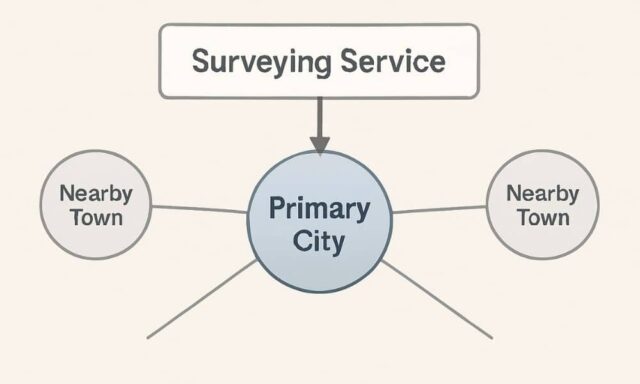
One core service + one primary geographic focus per page.
For example:
- Boundary Surveys in Huntsville, AL
- Topographic Surveys for Madison County Developments
Each page should focus on a main area where you regularly perform work. Nearby towns can be mentioned naturally, but they should support—not compete with—the main location.
Avoid creating dozens of near-duplicate city pages. If you don’t have meaningful context for a location, it’s better not to force it.
Using Local Context Without Keyword Stuffing
Strong service-area pages explain why the service is needed in that area.
This can include:
- References to local zoning requirements
- Types of properties common in the area
- Development patterns or land use considerations
- General permitting or boundary concerns
This kind of context signals real local understanding—something both Google and potential clients value.
Why This Structure Improves Long-Term Rankings
Clear service-area structure reduces confusion. It helps Google confidently match your business to relevant local searches.
Over time, this leads to:
- More stable rankings
- Stronger relevance in core areas
- Easier support from future project or content pages
For land surveyors, success in local search isn’t about listing every city. It’s about clearly showing where your expertise is actively applied.
When Google understands where the work actually happens, visibility becomes much easier to earn—and much harder to lose.
