
Google Business Profile Service Areas That Hurt Rankings
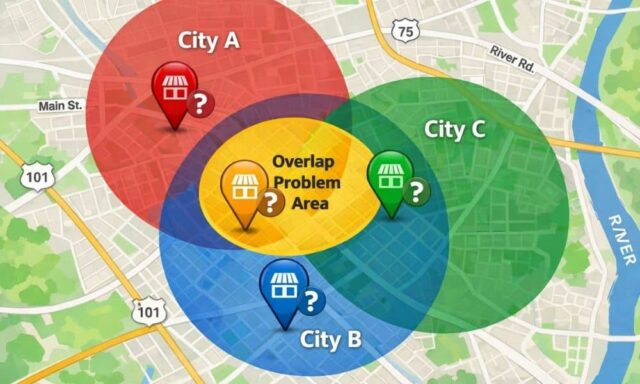
For service-based businesses like land surveyors, engineers, and contractors, service areas inside a Google Business Profile can cause problems instead of helping. Many businesses believe that adding more cities will increase visibility. In reality, poorly set service areas can create competition inside the same profile. They can confuse location signals and lower rankings. This is common in places like Frisco, Texas, where many cities are close together.
To avoid rank cannibalization, it is important to understand how Google reads service areas.
Why Google Needs One Clear Geographic Anchor
Google does not treat all service areas the same. It looks for one main location to understand where a business belongs. When a profile lists Frisco, Plano, McKinney, Dallas, and Fort Worth as equal areas, Google cannot tell which location matters most. This weakens distance signals. It can cause the business to show up less often or appear unevenly in map results.
If a business is based in Frisco, Frisco should be the clear main location. Photos, reviews, citations, and website content should support Frisco as the center of operations. Nearby cities should be shown as places you serve. They should not look like competing locations.
How Overlapping Cities Create Internal Competition
Rank cannibalization happens when service areas cover too much space or skip nearby cities. Listing cities that are far apart gives Google mixed location signals. Instead of ranking well in nearby areas, the business becomes only partly relevant in many places. It becomes strong in none.
This problem is common in North Texas. Frisco, Plano, and McKinney share many of the same searches. When service areas do not follow a clear map pattern, Google may change rankings often. It may also lower visibility in favor of businesses with clearer locations.
Why Service Areas Are Not a Keyword Tool
Service areas are often used the wrong way. Adding cities only because they have search volume does not help. It makes location signals less clear. Google expects service areas to match real work locations. It does not expect them to list places a business wants to reach.
When a city is listed but not supported by website content, reviews, or real projects, trust in the entire profile goes down. This matters more for professional services. Google uses stricter rules to judge relevance in these fields.
Why Website Location Signals Must Match
Google looks at service areas together with the business website. If a profile lists many cities but the website focuses on only one, Google struggles to connect the information. The same problem happens when website pages compete with each other. This mismatch is a common reason rankings stop improving.
Clear matching helps. A Frisco-based profile paired with a Frisco-focused website creates a clear location story. Simple mentions of nearby cities support that story. Google can understand this more easily.
Why Fewer, Clearer Service Areas Work Better
The strongest profiles are not the ones that list the most cities. They are the ones that are easiest to understand. Businesses that clearly show where they work and focus on one main location tend to rank more consistently. Forced expansion often causes problems instead.
Service areas work best when they explain coverage. They do not work well when used to chase visibility.
Conclusion
Service areas provide context. They are not a fast way to grow. When set the right way, they help Google understand where a business belongs and when it should appear in search results. When stretched too far or poorly matched, they create internal competition that lowers rankings.
For service businesses, clarity matters more than coverage. Google rewards businesses that make geographic sense, not those that try to appear everywhere at once. In practice, keeping that clarity across profiles, websites, and real service areas often comes down to applying professional local marketing guidance in how location signals are set and maintained over time.
