
Why Your Pages Compete on Google And How to Fix It
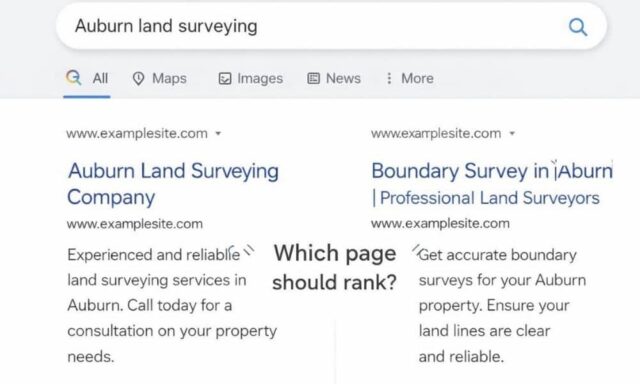
Local service businesses often assume that adding more pages increases their chances of ranking. In reality, the opposite can happen. When both your homepage and a service page target the same keyword, Google is forced to choose between them. Instead of strengthening your presence, it creates confusion—and your rankings become inconsistent.
This issue is called keyword cannibalization, and it quietly affects many websites without being obvious. You may still appear in search results, but the wrong page shows up, or your position fluctuates week to week and over time, you’ll notice your rankings keep shifting between pages, even when nothing on your site seems to have changed. That instability costs clicks and, ultimately, leads.
Why Google Struggles to Choose Between Your Pages
When two pages send the same signals—same keyword, same location, similar wording—Google sees them as competing options. Your homepage might say “Auburn land surveying,” and your service page says nearly the same thing. From Google’s perspective, both pages look equally relevant.
Instead of ranking both strongly, Google often rotates them or suppresses one. This creates a pattern where your homepage ranks one week, then disappears while the service page appears the next. Neither page builds enough authority to stay consistently visible.
How to Decide Which Page Should Rank
The fix starts with a clear decision. One page must take priority for the main keyword.
If the search term is broad and business-focused, the homepage usually makes more sense. If the search is tied to a specific service, then the service page should take ownership. The key is not which page you prefer—it’s which page better matches what the user is actually looking for.
Once that decision is made, everything else on your site should support it.
Reshaping the Secondary Page Without Removing It
The page that is not chosen should not be deleted. It still has value, but it needs a different role.
Instead of targeting the same keyword, it should shift toward a more specific angle. That could mean focusing on a type of project, a detailed process, or a common customer situation. By doing this, the page becomes complementary rather than competitive.
The goal is not to remove local relevance, but to remove duplication in intent. When both pages try to answer the same question, neither performs well.
Strengthening Signals So Google Understands the Structure
Once the pages are clearly separated, your content and structure need to reinforce that distinction. The primary page should carry the strongest, most direct version of the keyword. The secondary page should sound different—more specific, more contextual, and less repetitive.
Internal links also play a role here. When your site consistently points the main keyword toward one page, it sends a clear signal about which page should rank. Mixed signals, on the other hand, keep the confusion alive.
What Stability Looks Like After the Fix
After resolving cannibalization, the biggest change is not a sudden jump in rankings—it’s stability. One page begins to hold its position instead of alternating with another. Google no longer has to guess which page to show.
In a competitive but smaller market, that clarity can make a noticeable difference. When your site stops competing with itself, it becomes easier for Google to trust your content—and easier for potential clients to find the right page the first time.
