
Why Updating Old Pages Can Beat Publishing New Ones
Many businesses believe they need to publish new articles every week to improve their search visibility. New content certainly has value, but it isn’t always the fastest way to see better results. In many cases, improving pages that already exist produces a bigger impact than creating brand-new ones.
Older pages already have something working in their favor. Search engines have indexed them. They may already receive visitors, earn backlinks or appear in search results. Updating those pages helps build on that foundation instead of starting from zero. It’s also one of the most effective online marketing strategies for improving long-term visibility without constantly creating new content.
A website filled with outdated information gradually loses value. A website that regularly improves its best content gives both search engines and AI search systems more reasons to recommend it.
Older Pages Already Have SEO Value
Every page on your website builds authority over time.
Search engines have already indexed it. Other websites may have linked to it. Visitors may have spent time reading it or shared it with others. Those signals don’t disappear just because the page gets older.
If a page already appears in search results but isn’t ranking as well as you want, updating it is often more effective than writing another article targeting the same topic.
Simple improvements can make a noticeable difference.
You might:
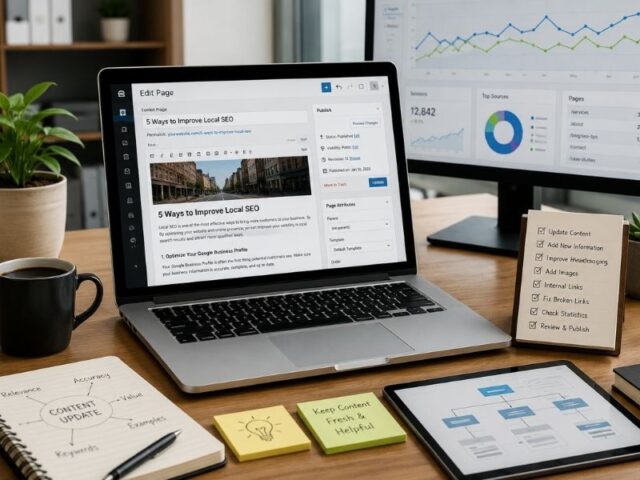
- Add new information.
- Answer questions customers ask most often.
- Replace outdated statistics or references.
- Improve headings and page structure.
- Add recent project photos.
- Fix broken internal or external links.
These updates show search engines that the page is still accurate, relevant and useful.
Instead of creating multiple pages that compete against each other, strengthen the page you already have.
Fresh Information Builds More Trust
People expect the information they find online to be current.
When visitors land on a page with outdated services, old images or broken links, they may wonder if the business is still active. That doubt can reduce trust before they ever make contact.
Review your older pages regularly to make sure they still reflect your business today.
Check that:
- Services are still available.
- Phone numbers and contact details are correct.
- Business hours match your online business listings.
- Images reflect your recent work.
- Internal links still lead to the right pages.
For example, a land surveying company should update service pages when new technology becomes common or industry standards change. A masonry contractor can strengthen older pages by adding recent project photos or expanding information about brickwork services, stone repair or retaining walls.
Small improvements help visitors find accurate information while giving search engines confidence that the page remains valuable.
Updated Pages Match Today’s Search Intent
The way people search continues to change.
Instead of typing a few keywords, many now ask complete questions through AI-powered search tools. They expect detailed answers rather than short summaries.
Pages written several years ago often miss those newer questions.
Updating older content gives you the opportunity to fill those gaps.
For example, a page about an ALTA survey shouldn’t only explain what the survey is. It can also answer questions about when lenders require one, how long the process usually takes and what documents clients should prepare before ordering one.
Adding these details doesn’t change the main topic. It simply makes the page more useful.
The same approach works for nearly every local business.
Look at the questions customers ask during phone calls or consultations. If those answers aren’t already on your website, add them. Over time, your pages become stronger resources for both visitors and AI search systems.
Better Content Strengthens Your Entire Website
Updating one page often benefits many others.
Most websites use internal links to connect related services and articles. When one important page becomes more helpful, every page linking to it also becomes more valuable.
Visitors spend more time exploring a website that answers their questions thoroughly. Instead of leaving after reading one page, they continue learning about related services.
This stronger connection between pages also helps search engines understand your website more clearly.
A well-organized website makes it easier to identify your areas of expertise.
Instead of publishing dozens of short articles every month, focus on making your most important pages as complete and useful as possible.
One excellent page can outperform several average ones.
Create a Simple Content Update Schedule
Many businesses publish content once and never look at it again.
Over time, those pages become outdated.
The better approach is to review your website on a regular schedule.
Every few months, look at your most important pages and ask yourself a few questions.
- Is the information still accurate?
- Have your services changed?
- Are customers asking new questions?
- Have competitors published information that your page doesn’t cover?
- Can you add recent projects or better examples?
The answers will show where updates are needed.
You don’t have to rewrite the entire page every time.
Sometimes adding one new section, replacing outdated photos or improving a few paragraphs is enough to make the content useful again.
Publishing new content will always be part of a successful SEO strategy. But ignoring the pages you already have is one of the biggest mistakes local businesses make.
A balanced approach works best. Continue creating new content while regularly improving the pages that already bring visitors to your website.
Quality content stays valuable because it continues to evolve.
