
How Service-Area Confusion Affects Local Visibility
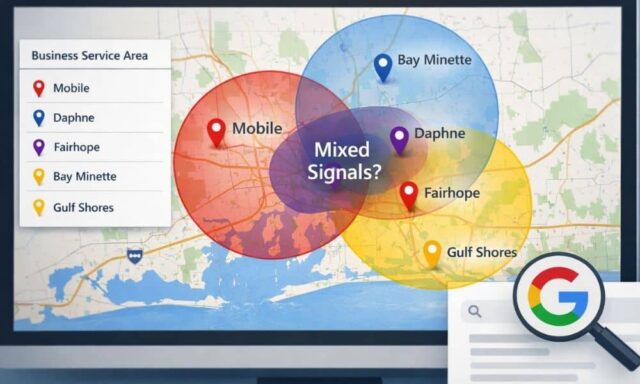
Many local service businesses in Mobile deal with a problem they don’t see right away. Their business looks active and professional, but their visibility changes from one nearby city to another. Some weeks feel busy. Other weeks feel slow. Nothing inside the business has changed, yet results feel uneven.
In most cases, this isn’t caused by competition or lower demand. It happens because of service-area confusion. This means Google is unsure where the business actually works, even if the business itself knows exactly where it goes.
When location signals stop matching
Google looks for patterns. It tries to understand where a business is based and where it regularly provides service. When the signals don’t match, Google hesitates.
This often happens when a business lists many nearby cities in its Google Business Profile, but the website tells a slightly different story. The profile may suggest wide coverage, while the website focuses more on Mobile or uses different city names. Even small differences can create doubt.
Instead of ranking lower, the business becomes harder for Google to place at all.
Why smaller, clearer service areas work better
It feels logical to list more cities to reach more people. But for many service businesses, this spreads the signal too thin.
When a company clearly serves Mobile and a few nearby cities on a regular basis, Google begins to recognize consistent service patterns tied to real work. This happens over time as projects repeat in the same places, the same routes are covered, and the same locations show up again and again—exactly how land surveyors serving the area tend to operate in practice.
When coverage feels too wide or unclear, Google struggles to decide where the business belongs. Clear service areas remove that uncertainty and make it easier for Google to show the business with confidence.
How the website helps clear the confusion
The website’s role is simple: confirm what’s true.
When the website clearly states the same service areas shown on Google Business Profile, it supports trust. When city names change across pages or appear randomly, that trust weakens.
A single page that explains where the business works, written in plain language, gives Google one strong reference point. This works better than spreading city mentions across many pages.
Why this matters in a market like Mobile
In mid-sized cities like Mobile, small changes can have a big impact. Visibility doesn’t always fade slowly. Sometimes it appears and disappears without warning.
Fixing service-area confusion isn’t about doing more. It’s about being clear and consistent. When Google understands where a business truly operates, visibility usually becomes more stable — especially for service-based businesses operating.
