Why Local Businesses Should Build Pages Around Buyer Questions
Most small business websites are built around what the business wants to say. That’s backwards.
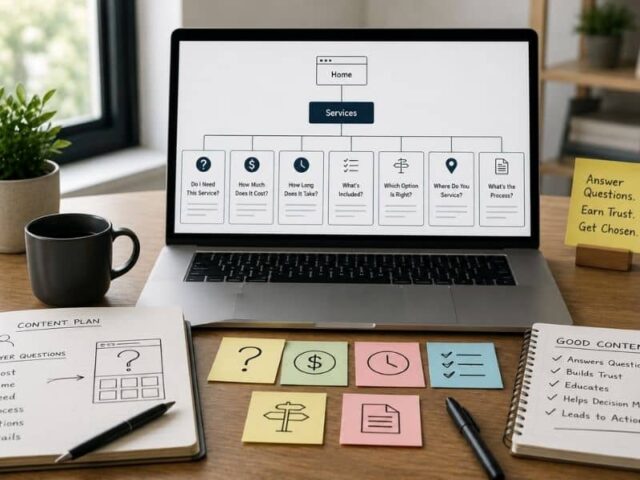
The stronger approach is building pages around what buyers are actually asking. For local businesses, this is where strong local business marketing starts: answering real questions before the customer ever calls.
When someone searches before hiring a local company, they rarely type a business name. They search for answers.
They ask:
- How much does this cost?
- How long does it take?
- Do I even need this?
- What’s involved?
- Which option is right for me?
If your website doesn’t answer those questions, someone else’s probably will.
People Search With Questions, Not Keywords
Search behavior has changed. People no longer search with short keyword phrases as often as they once did. They type complete questions because they want complete answers.
That shift matters more than many business owners realize.
A generic “Services” page competes for broad, highly competitive terms. A page built around one specific buyer question often has much less competition because few businesses take the time to answer that question thoroughly.
Think about how you’d search if you needed a local service yourself. You probably wouldn’t start with a company name. You’d search for your problem first.
Your website should be built to meet that problem head-on.
Move From “About Us” to “Answer This”
Most local websites follow the same structure: Home, About, Services, Contact.
It’s organized around the business, not the customer.
Buyer-question pages flip that approach.
Instead of one page listing several services, create individual pages that each answer one question a real prospect asks at a specific stage of the buying process.
Rather than explaining everything your company does, each page helps someone solve one problem or understand one decision. That makes the content more useful and much easier for both people and search engines to understand.
Answers Build Trust Before the Phone Even Rings
People often decide whether they trust a business before they ever make contact.
A page that openly answers questions like “How much does this cost?” or “Do I really need this service?” tells visitors something important. You’re willing to educate them instead of forcing them to call just to get basic information.
That openness builds credibility.
Often the biggest difference between two businesses with similar pricing isn’t the service itself. It’s that one explains things clearly while the other keeps everything behind a phone call.
Most people want answers first. Then they decide whether it’s worth reaching out.
Not Every Visitor Is Ready to Buy Today
Some visitors are ready to hire immediately.
Others are still trying to figure out whether they even have a problem.
Question-based content serves both audiences.
Someone searching “Do I need this service?” isn’t looking for an estimate yet. They’re looking for honest guidance. If your website provides it, your business becomes the one they remember when they’re ready to move forward.
Buyer Questions Change by Industry
The questions people ask depend on both where they are in the buying process and the type of business they’re researching.
Every local business has its own set of buyer questions. A restaurant may get questions about catering, menu options, or hours. A contractor may get questions about timelines, permits, or pricing. A professional service business may get questions about when expert help is needed.
For example, someone researching civil engineering may not be ready to hire yet. They may first want to understand site planning, drainage, permitting, land development, or construction requirements. These aren’t simple “About Us” questions. They’re real project questions from people trying to understand what step comes next.
The same principle applies across nearly every industry. Whether someone is looking for a contractor, accountant, attorney, engineer, landscaper, or another local service provider, they usually begin with questions instead of company names.
The more clearly your website answers those questions, the easier it becomes for the right visitor to trust your business and take the next step.
Build the Library One Question at a Time
You don’t have to redesign your entire website to get started.
Begin with one question. Answer it well. Then publish another.
Over time, those pages become a library of helpful resources that serves customers at every stage of their decision-making process.
The best source for ideas isn’t keyword research alone. It’s your own team.
Think about the questions people ask during sales calls, consultations, estimates, follow-up emails, and customer reviews. If the same question comes up repeatedly, it deserves its own page.
Some of the best topics include:
- Cost questions: “How much does this typically cost?”
- Timeline questions: “How long does this take?”
- Comparison questions: “Which option is right for my situation?”
- Necessity questions: “Do I actually need this service?”
- Warning-sign questions: “How do I know it’s time to call someone?”
If customers ask the question repeatedly, chances are other potential customers are searching for it online too.
Keep Each Page Focused
A strong buyer-question page doesn’t try to answer everything.
Start with a headline that matches the question people are actually asking.
Answer it immediately instead of making readers search through the page. Support your answer with clear explanations, practical examples, and specific details instead of broad marketing claims.
Finish with a clear next step, whether that’s requesting an estimate, scheduling a consultation, or learning more about a related topic.
The goal isn’t simply to publish more content.
The goal is to create the right content—organized around the questions buyers already have before they’re ready to hire.
